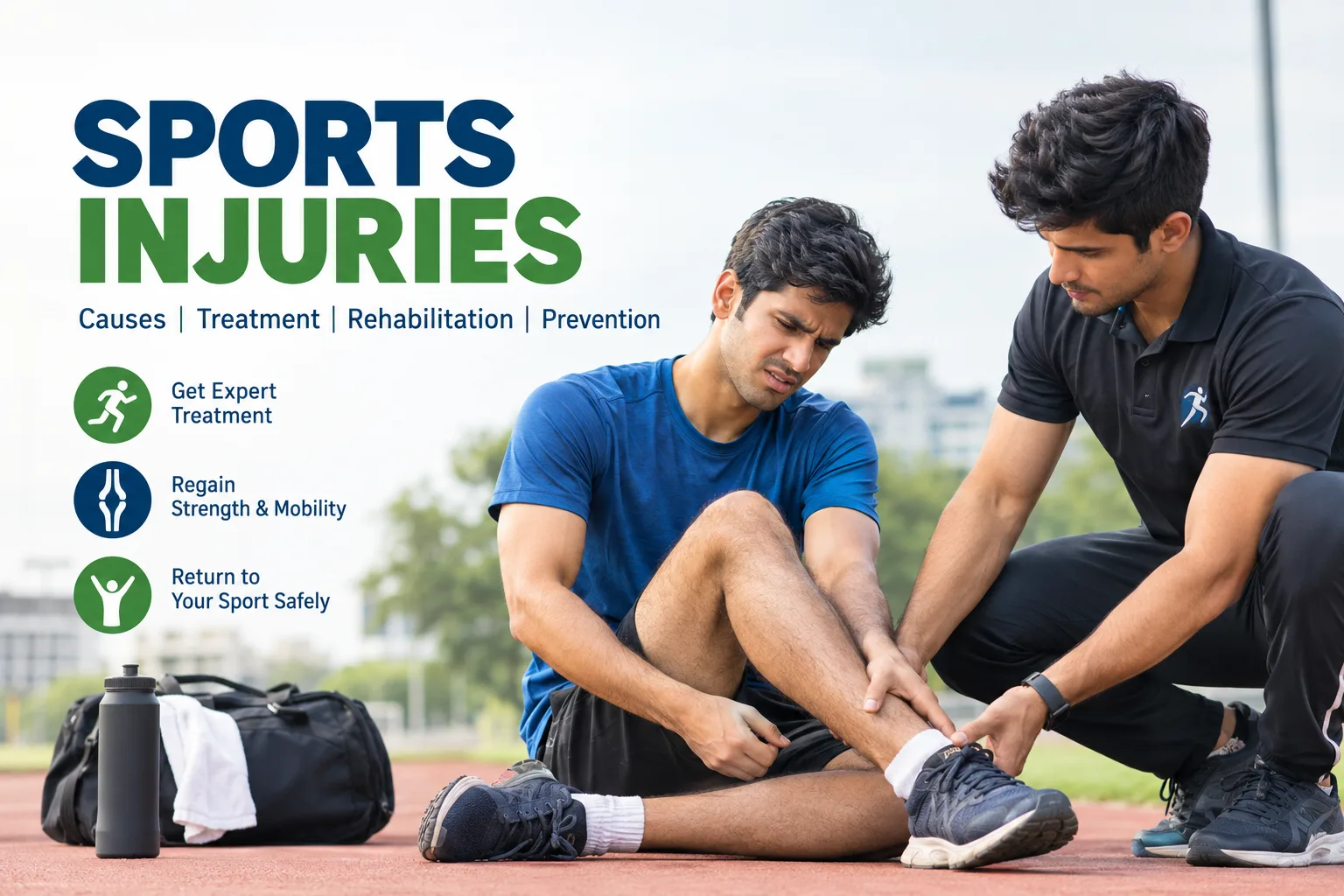
Sports and physical activity are excellent for maintaining strength, fitness, mobility and overall health. However, whether you are a professional athlete, a regular gym-goer, a recreational player or someone who participates in sports occasionally, injuries can happen at any level.
A sports injury may occur suddenly because of a fall, collision, awkward movement or excessive force. It can also develop gradually when a particular muscle, tendon, joint or bone is repeatedly exposed to stress without adequate recovery.
The good news is that many sports injuries can be effectively managed with appropriate treatment and structured rehabilitation. At our Sports injury Rehabiliation Therapy in Gurgaon, we have the expertise treatment for the same. Physiotherapy plays an important role not only in reducing pain but also in restoring movement, rebuilding strength, improving coordination and helping an individual return to their sport safely.
Importantly, being pain-free does not always mean that you are ready to return to sports. A successful recovery involves restoring the physical abilities required for the demands of the particular activity and addressing the factors that may have contributed to the injury in the first place.
What Are Sports Injuries?
Sports injuries are injuries that occur during participation in sports, exercise, training or other physical activities. They can affect muscles, tendons, ligaments, joints, bones and other soft tissues.
Sports injuries are generally classified into two broad categories:
1. Acute Sports Injuries
Acute injuries occur suddenly, often during a specific movement or incident.
Examples include:
- Ankle sprains
- Muscle strains
- Ligament injuries
- Dislocations
- Fractures
- Knee injuries
- Shoulder injuries
- Muscle tears
- Contusions or bruises
For example, a football player may twist their ankle while changing direction, while a runner may experience a sudden hamstring strain during sprinting.
2. Overuse Sports Injuries
Overuse injuries develop gradually because a particular body structure is repeatedly subjected to stress.
Common examples include:
- Tendinitis and tendinopathy
- Tennis elbow
- Runner’s knee
- Shin splints
- Stress fractures
- Shoulder overuse injuries
- Achilles tendon problems
Overuse injuries are often associated with sudden increases in training volume, inadequate recovery, poor technique or repetitive movements.
Common Causes of Sports Injuries
Sports injuries can occur for many reasons. Sometimes an injury is caused by a single event, while in other cases several factors contribute to it.
Some common causes include:
Inadequate Warm-Up
Starting intense physical activity without adequately preparing the body can increase the risk of injury. A suitable warm-up gradually increases body temperature, prepares the muscles and joints for movement and allows the body to transition into higher-intensity activity.
Muscle Weakness
Weak muscles may struggle to control movement effectively, particularly during running, jumping, landing or sudden changes in direction.
Strengthening the muscles surrounding vulnerable joints can therefore be an important part of both rehabilitation and injury prevention.
Poor Technique
Incorrect movement patterns can place excessive stress on certain tissues. Repeatedly performing an exercise or sporting movement with poor technique may contribute to overuse injuries.
Sudden Increase in Training
Increasing training intensity, distance, frequency or duration too quickly can place more stress on the body than it is prepared to handle.
A gradual progression allows tissues to adapt to increasing physical demands.
Inadequate Recovery
Rest and recovery are essential components of training. Continuously exercising without adequate recovery can contribute to fatigue, reduced performance and increased injury risk.
Previous Injury
A previous injury may increase the likelihood of another injury, particularly if strength, mobility, balance, coordination or sport-specific function has not been fully restored.
Inappropriate Equipment
Incorrect footwear, poorly maintained equipment or equipment that does not suit the activity may also contribute to injury.
Common Sports Injuries
Some sports injuries are particularly common among athletes and physically active individuals.
Ankle Sprains
An ankle sprain commonly occurs when the ankle twists or rolls beyond its normal range. Pain, swelling, tenderness and difficulty walking may occur.
Physiotherapy can focus on restoring ankle movement, strength, balance and proprioception before gradually progressing to running and sport-specific activities.
Muscle Strains
A muscle strain occurs when a muscle or tendon is overstretched or overloaded. Hamstring, calf, groin and quadriceps strains are common among runners and field-sport athletes.
Rehabilitation generally involves progressive strengthening rather than simply waiting for pain to disappear.
Knee Injuries
Knee injuries may involve muscles, tendons, ligaments, cartilage or other structures. Sports involving jumping, pivoting and sudden changes in direction can place considerable demands on the knee.
Examples include ACL injuries, meniscus injuries, patellar tendon problems and runner’s knee.
Shoulder Injuries
Shoulder injuries are common in activities involving repeated overhead movements, including swimming, throwing, badminton and certain gym exercises.
Treatment may involve improving shoulder mobility, rotator cuff strength, scapular control and movement mechanics.
Tennis Elbow
Despite its name, tennis elbow can affect anyone who repeatedly uses the forearm and wrist. It is commonly associated with pain around the outer elbow and discomfort during gripping or lifting.
Shin Splints
Shin pain can develop when the lower leg is exposed to repetitive loading, particularly following an increase in running or jumping activity.
Managing training load and progressively strengthening the lower limb are important components of recovery.
What Should You Do Immediately After a Sports Injury?
The appropriate immediate response depends on the nature and severity of the injury.
For many minor injuries, the initial priorities include protecting the injured area, managing symptoms and avoiding activities that significantly increase pain.
Compression and elevation may help manage swelling in some acute injuries. However, prolonged complete rest is not always necessary or beneficial. Current rehabilitation approaches increasingly emphasize an appropriate transition toward controlled movement and progressive loading when clinically suitable.
You should seek professional assessment if:
- Pain is severe or worsening
- There is significant swelling
- You cannot bear weight
- There is visible deformity
- You experience numbness or loss of function
- You suspect a fracture or major ligament injury
- Symptoms do not improve as expected
A physiotherapist or sports medicine professional can assess the injury and determine the appropriate rehabilitation pathway.
Role of Physiotherapy in Sports Injury Rehabilitation
Sports injury physiotherapy is not simply about reducing pain. The broader goal is to restore the physical qualities required for normal activity and sports performance.
A personalized rehabilitation program may address:
- Pain and swelling
- Joint mobility
- Flexibility
- Muscle strength
- Balance
- Coordination
- Proprioception
- Movement control
- Agility
- Power
- Sport-specific performance
A structured rehabilitation program can also help identify and address factors that contributed to the original injury. For detailed assessment and a guided roadmap, choose a professional physiotherapy partner.
Research on sports rehabilitation increasingly emphasizes progressive loading, neuromuscular retraining, workload management and criteria-based progression rather than relying only on a fixed recovery timeline.
Stages of Sports Injury Rehabilitation
Sports injury rehabilitation generally progresses through several stages. The exact approach varies depending on the injury, individual and sport.
Stage 1: Pain and Symptom Management
The initial objective is to control symptoms and protect the injured tissues from excessive stress.
The physiotherapist may recommend appropriate activity modification, gentle movements and other treatment strategies depending on the injury.
The goal is not necessarily complete inactivity but finding an appropriate level of movement that does not aggravate the injury.
Stage 2: Restoring Range of Motion
Once symptoms are under better control, rehabilitation focuses on restoring normal joint movement.
Gentle mobility exercises, stretching and controlled movements may be introduced according to the individual’s condition.
Restoring mobility is important because restricted movement can affect strength, technique and overall function.
Stage 3: Strength and Stability Training
Strengthening becomes increasingly important as recovery progresses.
Exercises may target the injured muscles as well as the surrounding joints and supporting muscle groups. Resistance training, balance exercises and neuromuscular training can help improve the body’s ability to control movement.
This stage is particularly important because returning to sport without adequate strength can increase the risk of reinjury.
Stage 4: Functional and Sport-Specific Rehabilitation
As strength and movement improve, rehabilitation becomes more specific to the individual’s sport.
Depending on the activity, this may include:
- Running
- Jumping
- Landing
- Sprinting
- Change-of-direction drills
- Agility exercises
- Throwing
- Kicking
- Sport-specific skills
The intensity and complexity of exercises are gradually increased.
Stage 5: Return to Sport
Returning to sport should be considered a gradual process rather than a single moment.
A physiotherapist may evaluate strength, movement quality, balance, agility and sport-specific performance before recommending unrestricted participation.
Return-to-sport decisions are complex and should consider physical recovery, the demands of the sport, psychological readiness and the individual’s risk factors rather than relying solely on the number of days or weeks since injury.
Why Functional Testing Matters Before Returning to Sports
One of the most common mistakes athletes make is returning to sport as soon as the pain disappears.
Pain reduction is encouraging, but it does not necessarily mean that strength, coordination and tissue capacity have returned to their previous levels.
Depending on the injury, rehabilitation may include:
- Strength comparison between limbs
- Balance testing
- Single-leg control
- Hop testing
- Jump and landing assessment
- Agility drills
- Running assessment
- Sport-specific movement testing
In some rehabilitation protocols, achieving approximately 90% or greater symmetry between limbs is used as one of several functional benchmarks. However, appropriate criteria vary according to the injury and sport.
The Psychological Side of Sports Injury Recovery
An athlete’s recovery is not purely physical.
After an injury, many individuals experience frustration, anxiety or fear of getting injured again. An athlete may physically be capable of performing a movement but still hesitate because they do not trust the injured body part.
Research has identified psychological readiness and fear of reinjury as important considerations in return-to-sport decisions.
Building confidence through gradual exposure to sport-specific movements can therefore be an important part of rehabilitation.
How to Prevent Sports Injuries
While not every injury can be prevented, several strategies can reduce the risk.
Warm Up Properly
Begin training with an appropriate warm-up that prepares the body for the activity.
Increase Training Gradually
Avoid sudden increases in training volume or intensity. Give your body time to adapt.
Strengthen Regularly
Strength training can improve the body’s ability to tolerate physical demands and control movement.
Work on Balance and Coordination
Balance and neuromuscular exercises can be particularly useful for athletes involved in running, jumping and rapid changes of direction.
Use Proper Technique
Correct movement mechanics can help distribute loads more effectively.
Allow Adequate Recovery
Include rest and recovery in your training schedule. Fatigue can affect movement quality and performance.
Do Not Ignore Persistent Pain
Continuing to train through persistent or worsening pain can allow a manageable problem to become more serious.
Complete Rehabilitation
Do not stop rehabilitation simply because you feel better. Completing the appropriate strengthening and functional stages is important for reducing the likelihood of reinjury.
Why You Should Not Rush Back After a Sports Injury
One of the biggest mistakes after an injury is returning to full activity too quickly.
An athlete may feel better after a few days and assume the injury has healed. However, tissues may still lack the strength and capacity required for high-intensity activity.
A premature return can result in:
- Recurrent injury
- Reduced performance
- Compensation in other areas of the body
- Persistent pain
- Longer rehabilitation
- Loss of confidence
A progressive return allows the body to gradually adapt to the demands of sport.
When Should You See a Physiotherapist for a Sports Injury?
You should consider professional assessment when pain affects your ability to walk, run, exercise or participate in sports, particularly if symptoms persist or repeatedly return.
A physiotherapist can assess the injured area, identify movement or strength deficits and develop an individualized rehabilitation program.
Physiotherapy may also be useful even after symptoms have improved because the final stages of rehabilitation focus on restoring function and preparing the body for the demands of sport.
Conclusion
Sports injuries can be frustrating, particularly for individuals who are passionate about staying active. However, an injury does not necessarily mean the end of your sporting activity.
With appropriate assessment, treatment and sports injury rehabilitation, many individuals can regain mobility, strength, confidence and sporting function.
The key is to avoid treating pain as the only measure of recovery. A successful return to sport requires progressive strengthening, movement control, balance, sport-specific conditioning and appropriate functional testing.
Most importantly, rehabilitation should be individualized. The right recovery plan depends on the type and severity of injury, your fitness level, the demands of your sport and your personal goals.
If you have suffered a sports injury, consulting a qualified physiotherapist at our Physiotherapy Clinic in Gurgaon can help you understand the injury, follow a structured recovery plan and return to activity more safely.
Frequently Asked Questions About Sports Injuries
1. What are the most common sports injuries?
Common sports injuries include ankle sprains, muscle strains, ligament injuries, knee injuries, shoulder injuries, tendinopathies, tennis elbow, shin splints and stress-related injuries. The type of injury often depends on the sport, training level and movement demands.
2. How long does it take to recover from a sports injury?
Recovery time depends on the type and severity of the injury. A mild strain or sprain may improve within a few weeks, while significant ligament injuries, fractures or injuries requiring surgery may take several months. Recovery should be based on functional progress rather than a fixed timeline.
3. Can physiotherapy help with sports injuries?
Yes. Physiotherapy can help restore mobility, strength, balance, coordination and functional movement following a sports injury. A structured rehabilitation program can also help prepare an athlete for a safe return to training and competition.
4. Can I return to sports once my pain has disappeared?
Not necessarily. Pain relief is only one part of recovery. Before returning to full sports activity, you may need to regain adequate strength, mobility, balance, movement control and sport-specific function. Returning too soon can increase the risk of reinjury.
5. How can I prevent sports injuries from happening again?
Complete your rehabilitation, strengthen the muscles involved in your sport, maintain good movement technique, warm up appropriately, increase training gradually and allow sufficient recovery. A physiotherapist can also identify individual risk factors and develop a sport-specific injury prevention program.