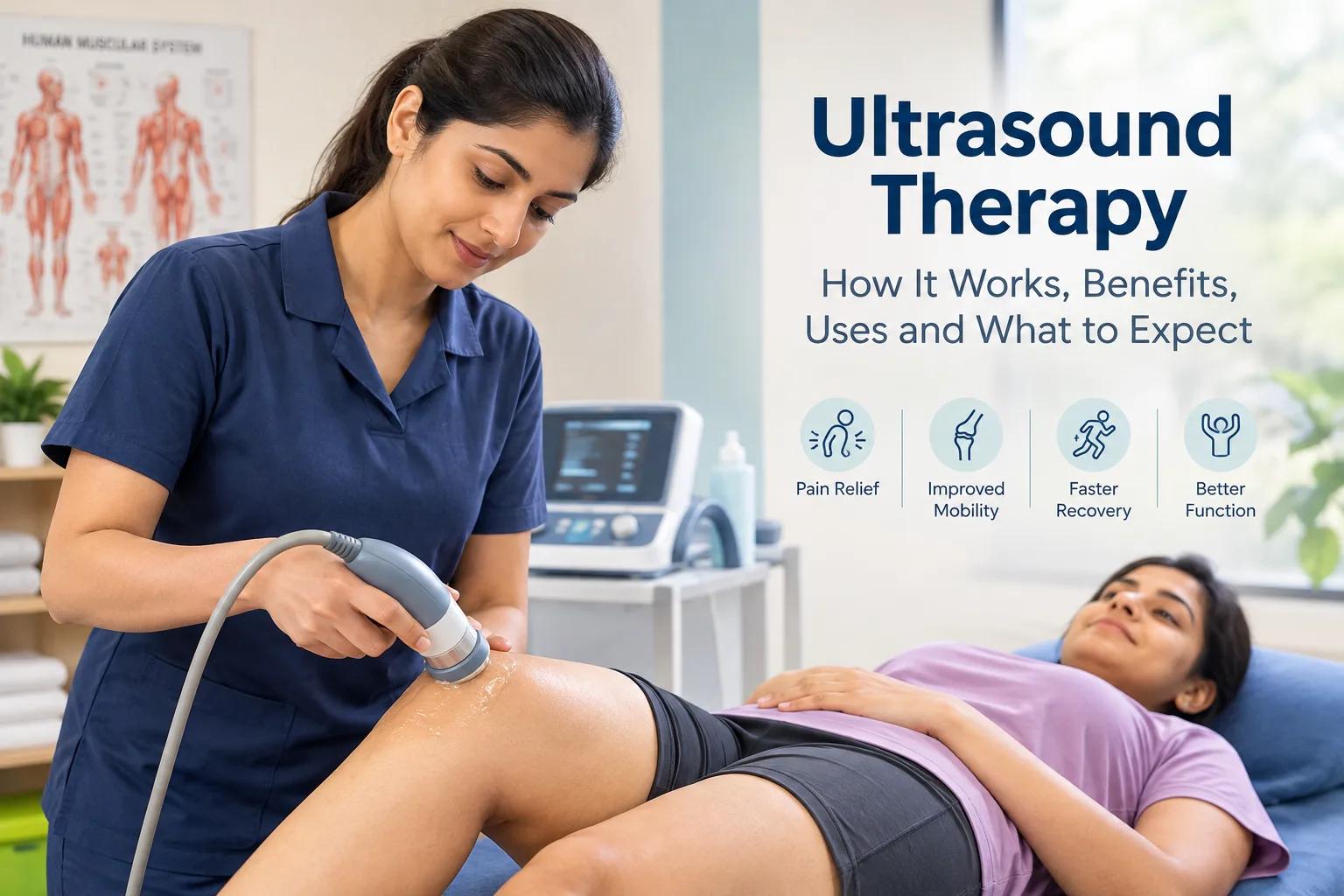
When pain, stiffness, or a soft-tissue injury limits your movement, physiotherapy can offer several non-invasive treatment options to support recovery. One such modality is Ultrasound Therapy, a technique that has been used in physiotherapy for decades to deliver therapeutic sound waves to targeted tissues.
Despite its name, therapeutic ultrasound is different from the ultrasound scans commonly associated with diagnostic imaging. In physiotherapy, ultrasound is used as a treatment modality rather than to create images of organs or tissues. A physiotherapist uses a handheld ultrasound applicator with a special coupling gel to deliver sound-wave energy to a selected area.
Ultrasound therapy may be incorporated into rehabilitation programs for certain muscle, tendon, ligament, joint, and soft-tissue conditions. However, it is important to understand that it is generally a supportive physiotherapy treatment rather than a stand-alone cure. Evidence for its effectiveness varies according to the condition being treated, and modern physiotherapy typically combines appropriate modalities with exercise, movement rehabilitation, education, and other clinically indicated techniques. Recent systematic reviews, for example, have found evidence of benefit in some knee conditions while results for shoulder conditions remain mixed.
What Is Ultrasound Therapy?
Ultrasound therapy in physiotherapy uses high-frequency sound waves that are above the range of human hearing. A therapeutic ultrasound machine produces these waves through a handheld treatment head, which is moved continuously over the treatment area with the help of ultrasound gel.
The gel is important because air can interfere with the transmission of ultrasound energy between the applicator and the skin. The coupling medium allows the sound-wave energy to pass more effectively into the targeted tissues.
Therapeutic ultrasound is generally delivered at frequencies such as 1 MHz or 3 MHz, with the choice depending on the treatment objective and the depth of the tissues being targeted.
Unlike diagnostic ultrasound, therapeutic ultrasound does not produce an image. Its purpose is to deliver acoustic energy to tissues as part of a physiotherapy treatment plan.
How Does Ultrasound Therapy Work?
The effects of therapeutic ultrasound are commonly discussed in terms of thermal and non-thermal effects.
1. Thermal Effects
When ultrasound is delivered continuously at appropriate parameters, it can produce a warming effect within tissues.
This controlled increase in tissue temperature may help:
- Improve tissue extensibility
- Reduce feelings of stiffness
- Prepare tissues for stretching or movement
- Support soft-tissue mobility
- Improve comfort during subsequent rehabilitation exercises
For example, a physiotherapist may use ultrasound before stretching or mobilization when stiffness is an important part of a patient’s presentation.
However, the amount of heating depends on factors such as frequency, intensity, treatment duration, tissue characteristics, and the way the applicator is used. Therefore, therapeutic ultrasound should be applied by a trained professional rather than treated as a generic heat treatment.
2. Non-Thermal Effects
Ultrasound can also be delivered in pulsed modes designed to minimize tissue heating. These settings are associated with mechanical effects such as acoustic streaming and cavitation.
These mechanisms have been investigated for their potential influence on cellular activity and tissue processes. However, the biological effects should not automatically be interpreted as proof that ultrasound will accelerate healing in every clinical condition.
The effectiveness of ultrasound therapy depends on the specific injury or condition, treatment parameters, and the overall rehabilitation program which we master at, Ultrasound Therapy in Gurgaon.
What Conditions Can Ultrasound Therapy Be Used For?
A physiotherapist may consider ultrasound therapy as one component of treatment for selected musculoskeletal and soft-tissue conditions.
Potential applications may include:
Muscle Strains
Muscle strains can occur when muscle fibers are overstretched or subjected to excessive force. Depending on the stage and severity of the injury, ultrasound may sometimes be incorporated into a broader rehabilitation program.
The primary goals of rehabilitation remain restoring movement, strength, flexibility, and functional capacity.
Tendon Problems
Conditions involving tendons, such as some forms of tendinopathy, may involve pain, stiffness, and reduced function.
Ultrasound therapy has historically been used for tendon-related problems, although research findings are not uniformly positive. Treatment should therefore be based on the individual’s diagnosis and should usually include appropriately prescribed loading and strengthening exercises.
Ligament Sprains
Ankle, knee, wrist, and other ligament sprains are common sports and everyday injuries. Ultrasound may sometimes be used as an adjunct during rehabilitation, particularly when soft-tissue symptoms are present.
However, restoring joint stability, range of motion, strength, balance, and functional movement is central to successful rehabilitation.
Joint Stiffness
When joint or surrounding soft-tissue stiffness restricts movement, therapeutic ultrasound may be used to provide a warming effect before mobility exercises or stretching.
Scar Tissue and Soft-Tissue Tightness
After surgery or injury, scar tissue can sometimes contribute to restricted movement. Depending on the individual situation, a physiotherapist may use various manual and therapeutic techniques to improve mobility.
Ultrasound may be considered as one part of this approach rather than as a treatment that independently removes scar tissue.
Plantar Fasciitis
Plantar fasciitis causes pain around the heel and bottom of the foot. Therapeutic ultrasound has been studied for plantar heel pain, but evidence regarding its effectiveness is mixed. A rehabilitation program commonly focuses on appropriate exercise, load management, calf and foot strength, and other individualized interventions.
Knee Osteoarthritis
Therapeutic ultrasound has also been investigated in people with knee osteoarthritis. A 2024 systematic review and meta-analysis evaluated studies examining ultrasound for pain and function in knee osteoarthritis, highlighting continued interest in its potential role while also emphasizing the importance of evidence-based treatment selection.
Benefits of Ultrasound Therapy
Depending on the condition and treatment goals, potential benefits of therapeutic ultrasound may include:
Non-Invasive Treatment
Ultrasound therapy does not involve needles, injections, or surgical incisions. It is generally performed externally on the skin.
May Help Prepare Tissues for Exercise
When thermal ultrasound is clinically appropriate, the warming effect may help prepare stiff soft tissues for stretching, mobilization, or therapeutic exercise.
Can Be Targeted
The physiotherapist can focus treatment on a specific region identified during the clinical assessment.
Can Be Combined With Other Physiotherapy Treatments
One of the most important advantages of ultrasound therapy is that it can be incorporated into a broader rehabilitation plan.
Depending on the patient’s condition, treatment may also include:
- Therapeutic exercises
- Strength training
- Stretching
- Manual therapy
- Joint mobilization
- Balance and coordination exercises
- Posture correction
- Activity modification
- Sports rehabilitation
- Home exercise programs
The American Physical Therapy Association emphasizes that modern physical therapy can involve assessment, patient education, hands-on treatment, movement, and exercise-based care tailored to the individual’s goals.
Is Ultrasound Therapy Effective?
This is an important question because ultrasound therapy is sometimes promoted as a universal solution for pain and tissue healing.
The reality is more nuanced.
Research examining therapeutic ultrasound has produced mixed results, depending on the condition being treated. A 2024 systematic review and meta-analysis found evidence supporting pain reduction in certain knee disorders, while findings for shoulder disorders were less convincing.
Other research has also reported limited or inconsistent benefits for particular musculoskeletal conditions. For example, evidence concerning plantar fasciitis and chronic joint pain remains variable.
This is why ultrasound should not be presented as a replacement for active rehabilitation.
A good physiotherapy program focuses on the underlying functional problem. Depending on the diagnosis, this may involve improving strength, mobility, joint control, flexibility, posture, endurance, or movement patterns.
Ultrasound therapy may be useful for selected patients, but the right treatment depends on the individual’s condition and assessment.
What Happens During an Ultrasound Therapy Session?
A typical ultrasound therapy treatment is simple and generally comfortable.
Step 1: Physiotherapy Assessment
Before treatment, the physiotherapist evaluates your symptoms, movement, pain pattern, medical history, and functional limitations.
Step 2: Positioning
You will be positioned comfortably so that the affected area can be accessed.
Step 3: Application of Gel
A layer of ultrasound coupling gel is applied to the skin. The gel helps transmit the ultrasound energy between the treatment head and the skin.
Step 4: Ultrasound Application
The physiotherapist moves the ultrasound applicator continuously over the selected area using appropriate settings.
You may experience mild warmth depending on the treatment mode and parameters, although therapeutic ultrasound should not normally be painful.
Step 5: Rehabilitation
Ultrasound may be followed by exercises, stretching, manual therapy, or other rehabilitation techniques depending on your condition.
The entire treatment plan is individualized according to your clinical needs.
How Long Does an Ultrasound Therapy Session Take?
The ultrasound component of a physiotherapy session is often relatively brief, although the exact duration depends on the size of the treatment area, condition, treatment parameters, and the overall rehabilitation plan.
The Painflame reference describes approximately 5–10 minutes as a typical ultrasound-treatment duration, while emphasizing that it is commonly incorporated into a larger physiotherapy session.
There is no universal number of sessions that applies to everyone. Your physiotherapist should determine the treatment frequency based on your diagnosis, response to treatment, and rehabilitation goals.
Who Should Avoid Ultrasound Therapy?
Although therapeutic ultrasound is a non-invasive modality, it is not appropriate for every person or every body area.
A physiotherapist should assess your medical history before treatment. Depending on the circumstances, ultrasound may be avoided or require special precautions over areas such as:
- Certain active or suspected tumors
- Some areas of acute infection
- Certain vascular conditions, including suspected deep vein thrombosis
- The eyes and reproductive organs
- Certain areas over developing bone in children
- Areas with impaired sensation where the patient cannot reliably report excessive heat or discomfort
- Some situations involving recent radiation treatment or significant tissue damage
The exact precautions depend on the ultrasound parameters, treatment location, diagnosis, and the patient’s medical history.
If you are pregnant, have a serious medical condition, have recently undergone surgery, or have an implanted medical device, tell your physiotherapist before treatment.
Do not use therapeutic ultrasound on yourself without professional guidance.
Ultrasound Therapy vs Diagnostic Ultrasound
These two technologies share the word “ultrasound,” but they serve different purposes.
Diagnostic ultrasound is primarily used to create images of internal structures.
Therapeutic ultrasound is used to deliver acoustic energy to tissues as part of a treatment program.
Therefore, receiving therapeutic ultrasound during physiotherapy does not mean that your physiotherapist is performing an ultrasound scan.
Why Should Ultrasound Therapy Be Combined With Exercise?
Pain relief is only one part of rehabilitation.
If an injury has caused weakness, stiffness, poor balance, reduced mobility, or altered movement patterns, simply reducing pain may not restore normal function.
Exercise can help address these underlying limitations.
For example, someone recovering from a sports injury may need:
- Pain and symptom management
- Restoration of range of motion
- Progressive strengthening
- Balance and coordination training
- Sport-specific movement
- Gradual return to normal activity
Ultrasound therapy, when appropriate, can be incorporated into this process, but it should not replace active rehabilitation.
Conclusion
Ultrasound Therapy is a non-invasive physiotherapy modality that uses high-frequency sound waves to deliver therapeutic energy to selected tissues. Depending on the treatment parameters and clinical condition, it may provide thermal or mechanical effects and can sometimes be used to support pain management, mobility, and rehabilitation.
However, ultrasound therapy should not be viewed as a magic solution for chronic pain or tissue injuries. Scientific evidence varies across conditions, and the most appropriate treatment depends on an accurate assessment of the individual patient.
For many musculoskeletal problems, a comprehensive physiotherapy program may combine symptom management with therapeutic exercise, strengthening, mobility work, manual therapy, posture correction, functional training, and education.
If you are experiencing persistent pain, stiffness, a sports injury, or restricted movement, consult a qualified physiotherapist at our Physiotherapy Center in Gurgaon for an assessment before beginning treatment. The right rehabilitation plan can then be designed around your condition, goals, lifestyle, and recovery requirements.
Frequently Asked Questions About Ultrasound Therapy
Therapeutic ultrasound is generally comfortable. Depending on the treatment settings, you may experience little sensation or mild warmth. If you experience significant pain, burning, or discomfort during treatment, inform your physiotherapist immediately.
There is no fixed number of sessions for everyone. The required treatment depends on the diagnosis, severity of symptoms, response to treatment, and overall rehabilitation plan. Your physiotherapist can determine the appropriate frequency after assessment.
Ultrasound therapy should not be considered a guaranteed cure or a stand-alone treatment. Its usefulness varies according to the condition. In many rehabilitation programs, it is used as an adjunct to exercise, manual therapy, education, and other appropriate interventions. Current research shows mixed effectiveness across different musculoskeletal conditions.
Home-use ultrasound devices exist, but therapeutic ultrasound requires appropriate knowledge of treatment parameters, dosage, treatment area, and safety precautions. Self-treatment without professional assessment may be ineffective or inappropriate. It is safer to have the treatment recommended and administered by a qualified physiotherapist.
No. Ultrasound therapy is not appropriate for every type of pain or every patient. Pain can have many different causes, including muscles, tendons, joints, nerves, the spine, or systemic conditions. A physiotherapy assessment is important to identify the likely cause and determine whether ultrasound has a role in your treatment.