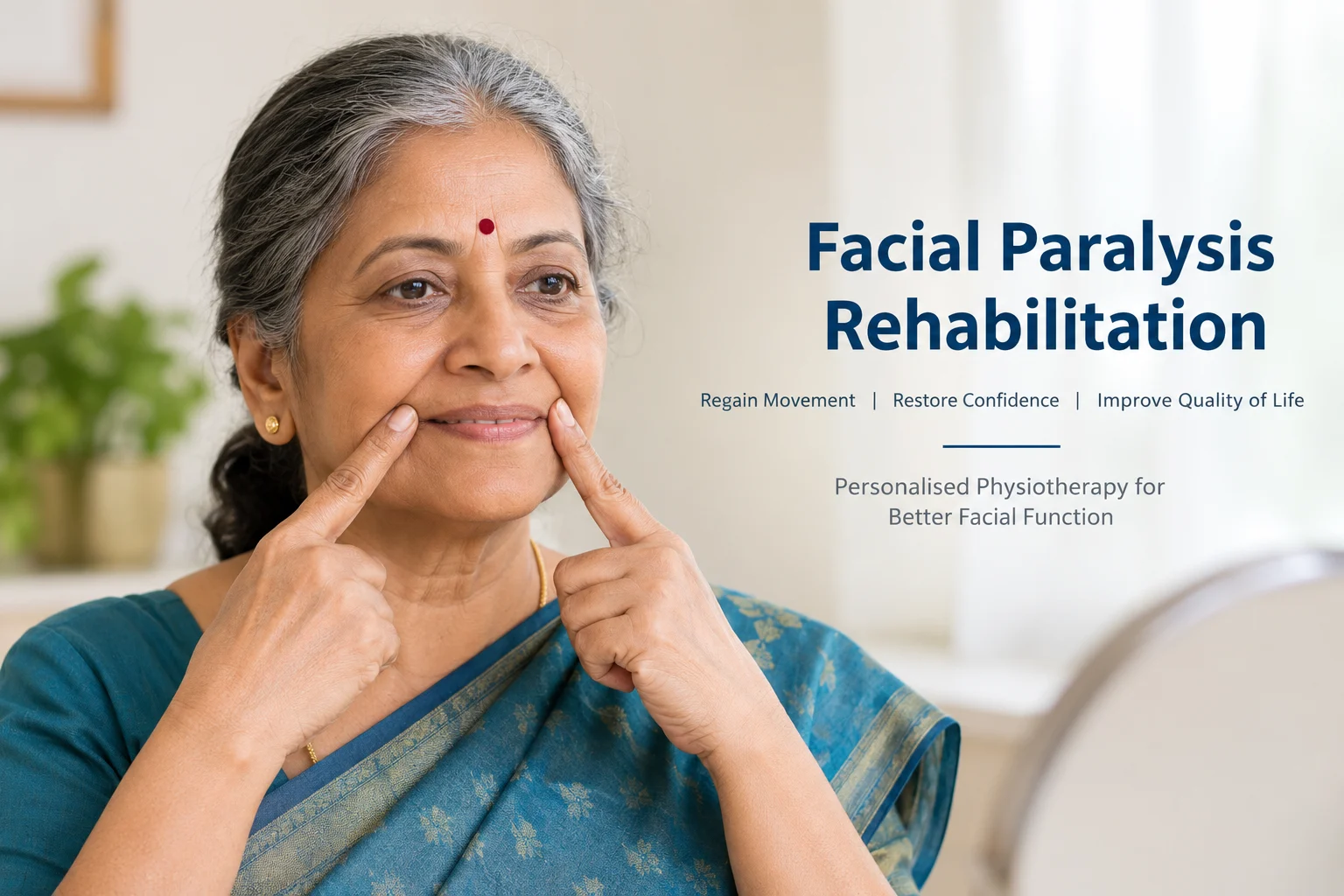
Facial paralysis is a neurological condition that affects the muscles responsible for facial expressions, including smiling, blinking, closing the eyes, raising the eyebrows, and moving the lips. It can develop suddenly or gradually, depending on its underlying cause, and may significantly affect a person’s ability to communicate, eat, drink, and express emotions naturally.
For many individuals, facial paralysis is not just a physical challenge. Changes in facial symmetry and expression can also affect self-confidence, social interactions, and emotional well-being. Fortunately, appropriate medical treatment and a personalised facial paralysis rehabilitation programme may help improve facial movement, muscle coordination, symmetry, and everyday function.
Facial paralysis can occur due to conditions such as Bell’s palsy, stroke, traumatic injuries, infections, or complications following certain surgical procedures. Since each cause affects the nervous system differently, identifying the underlying problem is essential before beginning rehabilitation.
Facial paralysis rehabilitation through physiotherapy focuses on helping patients regain controlled facial movements, manage associated symptoms, and make the best possible use of their recovering facial muscles. Treatment is tailored to the severity of the condition, the stage of recovery, and the individual’s functional goals.
This article explains the causes, symptoms, assessment process, physiotherapy techniques, recovery expectations, and benefits of facial paralysis rehabilitation.
What Is Facial Paralysis?
Facial paralysis is the partial or complete loss of voluntary movement in some or all of the muscles responsible for facial expression. It commonly affects one side of the face, although the pattern can vary depending on the underlying cause.
The facial nerve, also known as the seventh cranial nerve, controls most of the muscles involved in facial expressions. It also contributes to functions such as tear production, saliva production, and taste sensation from the front portion of the tongue.
When the facial nerve is damaged or the pathways carrying movement signals from the brain are affected, the facial muscles may become weak or lose their ability to move normally.
The severity of facial paralysis ranges from mild weakness to complete loss of movement. Some people experience temporary symptoms and recover substantially, while others may have persistent weakness, muscle tightness, or involuntary movements that require longer-term rehabilitation.
Facial paralysis should be distinguished from facial weakness caused by a stroke or another neurological condition. Although these conditions can produce similar visible symptoms, their causes, medical management, and rehabilitation requirements may differ.
Common Causes of Facial Paralysis
Understanding the cause of facial paralysis is an important first step in developing an effective rehabilitation plan.
1. Bell’s Palsy
Bell’s palsy is a common cause of sudden facial weakness that usually affects one side of the face. It is generally associated with inflammation or dysfunction of the facial nerve, and the exact trigger is not always identifiable.
Symptoms may include difficulty smiling, an uneven appearance of the mouth, reduced forehead movement, and difficulty closing the affected eye.
Many people with Bell’s palsy improve over time. However, some experience residual weakness, facial tightness, or involuntary movements that may benefit from specialist assessment and tailored facial neuromuscular retraining.
2. Stroke
A stroke occurs when blood flow to part of the brain is interrupted or when bleeding damages brain tissue. Depending on the area affected, a stroke can cause facial weakness along with problems involving speech, limb movement, balance, or coordination.
Stroke-related facial weakness may require a broader neurological rehabilitation programme that addresses facial movement alongside other affected functions.
Important: Sudden facial drooping, particularly when accompanied by arm weakness, difficulty speaking, confusion, or vision problems, requires immediate emergency medical attention. Do not delay seeking help to try facial exercises or physiotherapy.
3. Facial Nerve Injury or Trauma
Road accidents, falls, head injuries, and fractures involving the skull may damage the facial nerve. The severity of the injury determines the extent of facial weakness and the likely recovery pathway.
Depending on the injury, management may involve medical monitoring, specialist treatment, surgery, and rehabilitation.
4. Post-Surgical Facial Paralysis
Certain procedures involving structures near the facial nerve may lead to temporary or persistent facial weakness. Rehabilitation may be recommended after the treating surgeon confirms that therapy is appropriate.
The treatment plan depends on the procedure performed, the condition of the nerve, and the amount of facial movement present.
5. Infections and Other Neurological Conditions
Certain infections, including those associated with painful blisters around the ear, can affect the facial nerve. Tumours near the facial nerve and other neurological conditions may also cause facial weakness.
A medical specialist should investigate persistent, progressive, recurrent, or otherwise unexplained facial paralysis to determine the appropriate treatment.
Symptoms of Facial Paralysis
The symptoms of facial paralysis vary according to the cause and severity of nerve dysfunction.
Common symptoms include:
- Weakness or drooping on one side of the face.
- Difficulty smiling or showing facial expressions.
- Inability to close one eye completely.
- Reduced ability to raise the eyebrow or wrinkle the forehead.
- Drooping of the corner of the mouth.
- Difficulty retaining liquids in the mouth while drinking.
- Difficulty chewing or controlling food inside the mouth.
- Changes in speech clarity due to reduced lip movement.
- Dryness, irritation, or excessive watering of the affected eye.
- Changes in taste or sensitivity to sound in some cases.
- Facial tightness or involuntary movements during recovery.
Some patients may develop synkinesis, a condition in which an intended facial movement triggers an unwanted movement elsewhere. For example, an attempt to smile may cause the affected eye to close involuntarily.
These symptoms can interfere with daily activities and emotional expression. Early medical assessment and an appropriate rehabilitation strategy can help patients understand their condition and identify suitable treatment options.
Why Is Facial Paralysis Rehabilitation Important?
Facial paralysis rehabilitation is designed to address the functional problems caused by reduced facial movement and impaired muscle coordination. While the facial nerve may recover naturally in some cases, rehabilitation can help patients learn how to use available movement more effectively.
The goals of facial paralysis physiotherapy may include:
- Improving control over facial expressions.
- Encouraging symmetrical movement where possible.
- Improving coordination between different facial muscles.
- Reducing excessive muscle tension and unwanted associated movements.
- Supporting activities such as speaking, eating, drinking, and blinking.
- Helping patients develop confidence during social interactions.
- Maintaining function and addressing persistent problems during long-term recovery.
Rehabilitation does not guarantee complete recovery, and its benefits depend on the cause, severity, and duration of facial paralysis. Research on physical therapy for Bell’s palsy has limitations, so treatment should be individualised rather than presented as a universally effective solution. Evidence suggests that tailored facial exercises may be useful for some people with persistent weakness, although the certainty of the evidence remains limited.
How Is Facial Paralysis Assessed Before Physiotherapy?
A comprehensive assessment helps the rehabilitation professional understand the patient’s condition and establish appropriate treatment goals.
1. Medical History and Symptom Review
The physiotherapist reviews when the symptoms began, how they have changed, and whether the patient has received a medical diagnosis. Previous infections, head injuries, surgery, stroke, and other relevant medical conditions may influence treatment decisions.
2. Facial Movement Assessment
The therapist observes the patient’s ability to perform movements such as:
- Raising the eyebrows.
- Closing the eyes gently.
- Smiling with the lips together.
- Showing the teeth.
- Pursing the lips.
- Moving the corners of the mouth.
- Performing coordinated facial expressions.
The assessment identifies which movements are weak, restricted, asymmetrical, or associated with unwanted muscle activity.
3. Facial Nerve Function and Severity
Clinicians may use standardised assessment tools, such as the House–Brackmann grading scale or Sunnybrook Facial Grading System, to document facial function and monitor changes over time.
These assessments help establish a baseline against which progress can be measured. Additional investigations, including nerve conduction studies or electromyography, may be considered by the medical team in selected cases.
4. Functional Assessment
The physiotherapist may also evaluate how facial weakness affects speaking, drinking, eating, blinking, and other everyday activities.
If the patient cannot close the affected eye fully, eye protection becomes a priority. Assessment findings guide the rehabilitation plan and help determine whether further medical or specialist input is required.
Physiotherapy Techniques Used in Facial Paralysis Rehabilitation
Facial paralysis rehabilitation should be tailored to the patient’s condition and stage of recovery. The following techniques may be incorporated when clinically appropriate.
1. Facial Neuromuscular Retraining
Facial neuromuscular retraining is a specialised rehabilitation approach that helps patients practise controlled, selective facial movements.
Instead of repeatedly forcing the muscles to move, the therapist guides the patient to perform small, accurate movements while avoiding unnecessary tension.
Examples may include gently attempting to raise an eyebrow, close the lips, or create a controlled smile. The therapist adjusts the movement according to the patient’s available muscle activity.
This approach is particularly relevant when a patient has regained some movement but struggles with coordination, asymmetry, or unwanted associated movements.
2. Mirror-Based Facial Exercises
Mirror feedback can help patients observe their facial movements and identify differences between the affected and unaffected sides.
Under professional guidance, patients may practise gentle movements while watching for excessive effort, compensatory movement, or asymmetry.
The emphasis is on accuracy and relaxation rather than performing a high number of repetitions. If an exercise produces unwanted movements or excessive tightness, the therapist may modify or discontinue it.
3. Gentle Facial Movement Practice
Depending on the patient’s condition, a physiotherapist may introduce controlled practice of selected facial expressions.
Examples can include:
- Gently bringing the lips together.
- Practising a small, controlled smile.
- Attempting mild eyebrow elevation.
- Practising lip movements relevant to speech.
- Working on relaxation between facial movements.
These activities should be prescribed according to the patient’s assessment. Forceful movements and repetitive exaggerated facial exercises are not appropriate for everyone, particularly when synkinesis or muscle tightness is present.
4. Relaxation and Soft-Tissue Techniques
Some patients experience tightness, discomfort, or a feeling of stiffness in the affected facial muscles during recovery.
A trained therapist may use gentle, appropriate soft-tissue techniques and relaxation strategies to help manage these symptoms. Treatment should be comfortable and should not involve aggressive pressure on the face.
These techniques are supportive measures rather than a way to repair a damaged facial nerve directly.
5. Biofeedback and Movement Awareness
In selected cases, visual or other forms of biofeedback may help patients become more aware of how individual facial muscles are moving.
The goal is to improve selective activation and coordination, especially when an intended movement triggers unwanted activity in another muscle group.
Biofeedback may be incorporated into a structured programme when the therapist considers it suitable.
6. Functional Rehabilitation
Facial paralysis can affect practical activities beyond facial appearance. Rehabilitation may therefore include movement practice related to specific functional difficulties.
Depending on the patient’s needs, the broader care team may address lip closure, oral control, speech clarity, eating, and drinking. A speech and language therapist may be required when communication or swallowing problems are present.
A coordinated approach can help ensure that treatment addresses the patient’s actual challenges rather than focusing only on facial symmetry.
7. Eye Protection and Eye-Care Guidance
When facial weakness prevents complete eyelid closure, the eye may become dry or vulnerable to injury. Protecting the eye is essential and should not be treated as an optional part of rehabilitation.
A medical professional may recommend lubricating eye drops or ointment, protective measures during sleep, or assessment by an eye specialist, depending on the severity of the problem.
Eye pain, redness, light sensitivity, visual changes, or persistent irritation requires prompt medical assessment. Physiotherapy exercises alone cannot protect the eye adequately when eyelid closure is impaired.
Facial Paralysis Rehabilitation at Different Stages of Recovery
Treatment needs can change as facial nerve function evolves. A personalised programme should be adjusted in response to clinical findings rather than following a fixed exercise routine.
Stage 1: Early Assessment and Protection
Initial phase
The priority is to establish the diagnosis, address the underlying cause, protect the affected eye, and manage immediate functional difficulties. The treating doctor determines appropriate medical treatment. Facial exercises should not delay urgent assessment or replace prescribed medication.
Stage 2: Emerging Facial Movement
Movement-retraining phase
When movement begins to return, carefully selected exercises may help the patient practise controlled facial activation. Mirror feedback and movement awareness can be introduced according to tolerance and clinical assessment.
Stage 3: Coordination and Symmetry
Functional control phase
When some facial movement is present, rehabilitation may focus on improving the quality of movement, reducing excessive effort, and managing asymmetry or synkinesis.
Stage 4: Long-Term Management
Maintenance and adaptation
People with persistent weakness may benefit from continued specialist care, an adapted home programme, and strategies to manage tightness, unwanted movements, and everyday functional limitations.
These stages are descriptive rather than a strict timetable. Some patients progress quickly, while others need prolonged treatment or additional specialist interventions.
How Long Does Facial Paralysis Rehabilitation Take?
The recovery period varies considerably from person to person. It depends on the underlying cause, the extent of nerve damage, the patient’s general health, and whether facial movement is returning.
Some people with Bell’s palsy experience noticeable improvement within weeks, with further recovery over several months. Others, particularly those with severe nerve injuries, stroke-related weakness, or postoperative complications, may require a longer rehabilitation period.
The following factors can influence recovery:
- Cause of paralysis: Bell’s palsy, stroke, trauma, and surgical nerve injuries have different recovery patterns.
- Severity of nerve damage: Partial nerve dysfunction may have a different prognosis from complete paralysis or significant structural injury.
- Time since onset: Early diagnosis and appropriate medical management are important, while persistent weakness may require specialised rehabilitation.
- Presence of synkinesis: Unwanted associated movements can complicate recovery and require targeted retraining.
- Consistency of rehabilitation: Following an individually prescribed programme can help patients practise the movement strategies recommended by their therapist.
There is no single recovery timeline that applies to everyone. Regular reassessment helps determine whether the current treatment plan is appropriate and whether additional specialist evaluation is needed. Persistent or incomplete recovery should be discussed with the treating doctor rather than managed through exercises alone.
Exercises to Avoid or Approach With Caution
Although facial exercises are commonly discussed in facial paralysis recovery, performing more exercises does not necessarily lead to better results.
Patients should avoid the following unless specifically advised by a qualified rehabilitation professional:
- Forcing the mouth into an exaggerated smile.
- Repeatedly attempting strong facial contractions when movement is limited.
- Performing exercises that trigger eye closure or other unwanted movements.
- Applying aggressive massage or pressure to the affected side of the face.
- Using electrical stimulation devices without appropriate professional assessment.
- Following generic online exercise routines without considering the cause and stage of paralysis.
The appropriate approach is to practise controlled, comfortable movements with an emphasis on movement quality. Patients with synkinesis or significant facial tightness may require a different programme from those with early, flaccid weakness.
Evidence for physiotherapy interventions varies, and electrical stimulation should not be assumed to be beneficial for every patient. A clinician experienced in facial nerve rehabilitation can determine which interventions are appropriate.
Lifestyle Tips to Support Facial Paralysis Recovery
Physiotherapy is only one component of comprehensive recovery. Daily habits and appropriate medical follow-up also matter.
1. Follow Medical Advice
Take prescribed medication as directed and attend follow-up appointments. Bell’s palsy and other causes of facial weakness may require time-sensitive medical treatment.
2. Prioritise Eye Care
If the affected eye does not close completely, follow the eye-protection plan recommended by your doctor. Seek prompt medical attention for irritation, pain, redness, or changes in vision.
3. Practise Exercises Correctly
Perform only the movements prescribed by your physiotherapist. Focus on gentle, accurate movement rather than force or repetition.
4. Maintain Balanced Nutrition and Hydration
A balanced diet, adequate hydration, and sufficient rest support general health. If facial weakness makes eating or drinking difficult, seek professional advice about safe food textures, swallowing, and oral control.
5. Address Emotional Well-Being
Changes in facial expression can affect confidence and social interaction. Discuss these concerns with your healthcare team, and consider psychological support if the condition is affecting your mood or quality of life.
6. Attend Regular Reviews
Keep track of changes in facial movement, eye closure, muscle tightness, and everyday function. If symptoms worsen or new neurological symptoms develop, seek medical evaluation promptly.
Choosing the Right Facial Paralysis Rehabilitation Programme
A suitable rehabilitation programme at an expert physiotherpy center should be based on a thorough assessment rather than a standard set of exercises offered to every patient.
When selecting a physiotherapy provider, consider whether the professional:
- Assesses the underlying diagnosis and relevant medical history.
- Evaluates facial movement, symmetry, and coordination.
- Understands the differences between facial nerve paralysis and stroke-related facial weakness.
- Recognises and manages synkinesis appropriately.
- Provides an individualised home exercise programme.
- Monitors progress and adjusts treatment when necessary.
- Coordinates care with neurologists, ENT specialists, ophthalmologists, or other healthcare professionals when required.
For patients who have difficulty travelling, home physiotherapy may be an option if an appropriately trained professional is available and the patient’s clinical needs can be managed safely at home.
The objective should be to improve function and quality of life while setting realistic expectations about recovery.
Conclusion
Facial paralysis can affect much more than facial appearance. It may interfere with eye closure, speaking, eating, drinking, emotional expression, and self-confidence. However, an accurate diagnosis, appropriate medical care, and a personalised rehabilitation plan can help patients address these challenges.
Facial paralysis rehabilitation focuses on improving facial movement, coordination, symmetry, and functional control. Depending on the patient’s condition, treatment may include facial neuromuscular retraining, mirror feedback, carefully selected facial exercises, relaxation techniques, and strategies to manage persistent weakness or synkinesis.
Recovery varies according to the cause and severity of the condition, and complete recovery cannot be guaranteed. Eye protection, regular medical reviews, and guidance from qualified healthcare professionals are essential parts of the process.
If you or a family member is experiencing facial weakness, seek medical evaluation promptly before starting exercises. With the right diagnosis and an individualised approach, rehabilitation can help patients work towards better facial function and improved everyday living.
Frequently Asked Questions (FAQs)
1. What is facial paralysis rehabilitation?
Facial paralysis rehabilitation is a specialised treatment approach designed to help people with facial weakness improve movement control, coordination, symmetry, and everyday function. Depending on the underlying cause, it may involve facial neuromuscular retraining, mirror-based feedback, gentle exercises, and strategies to manage muscle tightness or unwanted associated movements.
2. Can physiotherapy help treat facial paralysis?
Physiotherapy may help selected patients, particularly those with persistent facial weakness or difficulties controlling facial movements. Treatment is individualised according to the cause, severity, and stage of recovery. Evidence supporting specific physiotherapy techniques is limited, and rehabilitation cannot guarantee complete recovery or replace necessary medical treatment.
3. How long does facial paralysis rehabilitation take?
The duration varies according to the cause of facial paralysis and the extent of nerve damage. Some people with Bell’s palsy improve over several weeks or months, while others may require longer-term rehabilitation. Regular assessment helps the treating team monitor progress and modify the treatment plan.
4. Which exercises are recommended for facial paralysis?
Depending on the clinical assessment, a physiotherapist may prescribe gentle eyebrow movements, controlled lip closure, small smiles, and mirror-guided facial movement practice. The exercises should be tailored to the patient’s abilities. Forceful contractions and repetitive exaggerated movements should be avoided unless specifically recommended by a qualified professional.
5. Can facial paralysis be completely cured?
Complete recovery is possible in some cases, but it depends on the underlying cause, the severity of nerve damage, and the individual’s response to treatment. Some people experience residual weakness, facial asymmetry, or synkinesis. Medical treatment, appropriate rehabilitation, and specialist follow-up can help address these problems, although complete recovery cannot be guaranteed.