Bell's Palsy
Sudden one-sided facial weakness with no other identified cause. Physiotherapy supports movement recovery alongside medical care.
Physiotherapist-guided facial paralysis rehabilitation for Bell's palsy, post-stroke facial weakness and facial nerve injury, focused on safe facial movement, expression, eye care guidance and everyday function.
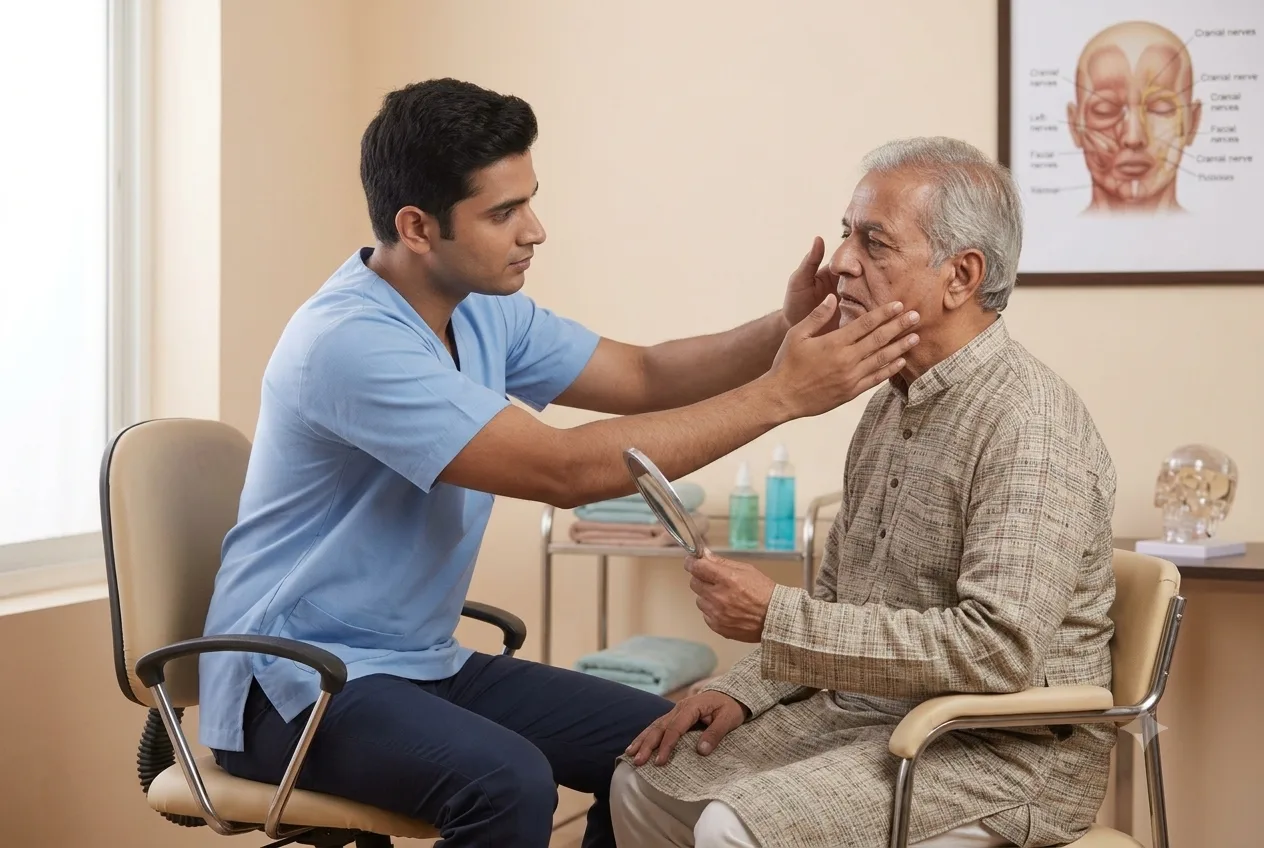
If your face has suddenly drooped, especially with arm weakness, speech difficulty or severe headache, go to an emergency department immediately. Rehabilitation supports recovery after medical evaluation.
Facial paralysis rehabilitation is a physiotherapy-led programme that helps people with facial weakness or paralysis improve facial movement, symmetry, control and comfort through assessment-based exercise and education.
Facial paralysis (also called facial palsy) happens when the facial nerve or the brain pathways controlling it are affected. Common causes include Bell's palsy, stroke, Ramsay Hunt syndrome, injury and surgery. A physiotherapist does not treat the underlying medical cause but helps you rebuild movement and function once you have been medically evaluated.
Depending on your assessment, your plan may include facial neuromuscular re-education, gentle soft-tissue techniques, eye care and eating guidance, relaxation strategies and a home exercise programme.
Facial movement, symmetry and function are assessed before a plan is made.
A physiotherapist decides which movements are appropriate for your stage of recovery.
Controlled, quality-focused facial exercises help retrain movement patterns.
Simple routines to practise between sessions and support steady progress.
Suitability and timing depend on the cause, stage of recovery and your doctor's guidance. A proper assessment should come before treatment.
Sudden one-sided facial weakness with no other identified cause. Physiotherapy supports movement recovery alongside medical care.
Facial weakness after stroke can be addressed as part of a wider neurological rehabilitation plan.
Facial weakness linked to viral infection of the facial nerve may need medical treatment first, followed by guided rehabilitation.
Weakness following surgery, head or facial injury may be rehabilitated once your surgeon or doctor advises it is appropriate.
Unwanted linked movements or tightness during recovery can be assessed, and exercise is adjusted accordingly.
Even when weakness has persisted for months, a physiotherapist can assess what movement and function can be improved.
Facial paralysis is more than a change in appearance. It can affect how comfortably you eat, speak, blink and express emotion, and it can affect confidence in social situations.
Your physiotherapist will ask which of these matter most to you so the programme focuses on your own goals.
Reduced blinking can leave the eye dry or irritated and needs medical attention.
Asymmetry can make smiling or showing emotion feel unnatural or effortful.
Weak cheek and lip control may cause food or liquid to collect or spill.
Lip and cheek weakness can make some sounds harder to pronounce clearly.
Your first visit includes a review of how your facial weakness began, your medical care so far and a physical assessment of facial movement, tone and function.
Treatment is then adjusted to your stage of recovery, since what helps in the early weeks may differ from what is needed later.
Facial movement, symmetry, muscle tone, eye closure, speech and eating are reviewed.
Warning signs are checked, medical referral is advised if needed, and goals are agreed.
Facial exercises, gentle techniques and functional practice are taught and supervised.
You practise a simple routine at home, and your plan is updated as movement returns.
Recovery depends largely on the cause and severity of nerve involvement. Rehabilitation aims to make the most of the movement you have and to help prevent avoidable complications.
In facial rehabilitation, large, forceful or repetitive movements can sometimes increase tightness or unwanted linked movements. Precise, well-dosed exercise guided by a physiotherapist is often more effective than doing more.
That is why your programme is individualized and reviewed regularly rather than followed from a generic video or handout.
Rehabilitation is generally considered after the cause of facial weakness has been medically evaluated. Your doctor and physiotherapist can advise on the right time to begin.
Go to an emergency department immediately if your face droops suddenly, especially with arm or leg weakness, difficulty speaking, confusion, vision changes or a severe headache. These can be signs of a stroke.
Any new facial weakness should be medically evaluated promptly, because some treatments are time-sensitive. If you cannot fully close an eye, or it is painful, red or dry, see a doctor as soon as possible to protect your eyesight.
A comprehensive plan combines different approaches according to your findings, stage of recovery and goals.
Controlled, individualized movements to retrain facial muscles and improve symmetry.
Light hands-on techniques and relaxation strategies to ease facial tightness when appropriate.
Practical strategies for eating, drinking, speaking and expressing emotion more comfortably.
A simple, safe routine and self-care guidance to continue progress between visits.
Calm n Cure Physiotherapy Center focuses on understanding your facial function, your medical history and your goals before choosing any technique, and is honest about what recovery may involve.
Book a physiotherapy assessment in Gurgaon. Our team can review your facial function and explain what a safe, realistic rehabilitation plan could look like.
Book an AssessmentCommon questions about facial palsy, recovery, exercises and physiotherapy care.
Share your basic details and concern. The Calm n Cure clinic team can discuss your symptoms, assessment requirements and the next appropriate step.
Medical note: Facial paralysis can be caused by conditions that need urgent medical care, including stroke. Sudden facial weakness should be evaluated by a doctor or emergency service without delay. Physiotherapy supports recovery of facial movement and function and does not replace medical diagnosis or treatment. Treatment should be recommended and administered by a qualified physiotherapist after an appropriate assessment. Recovery and outcomes vary from person to person.